


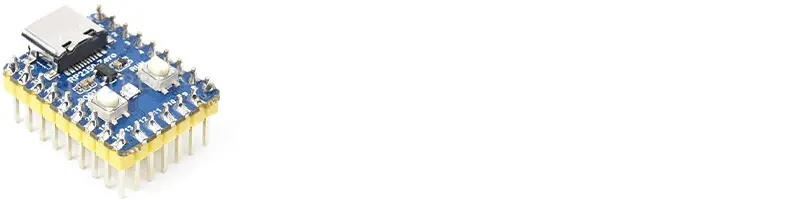
Raspberry Pi Pico 2 RP2350-Zero Mini Board RP2350A
72 in stock
$8.54 – $10.58
- Hign-concerned Chemical: None
- Compatible With: Pico 2
- Accessory Type: Extension Board
- Brand Name: spotpear
- Origin: Mainland China

RP2350-Zero Mini Development Board
Based on the Raspberry Pi RP2350A, all unused pins are brought out in a very small board
Using half-hole technology, it can be welded on a custom board
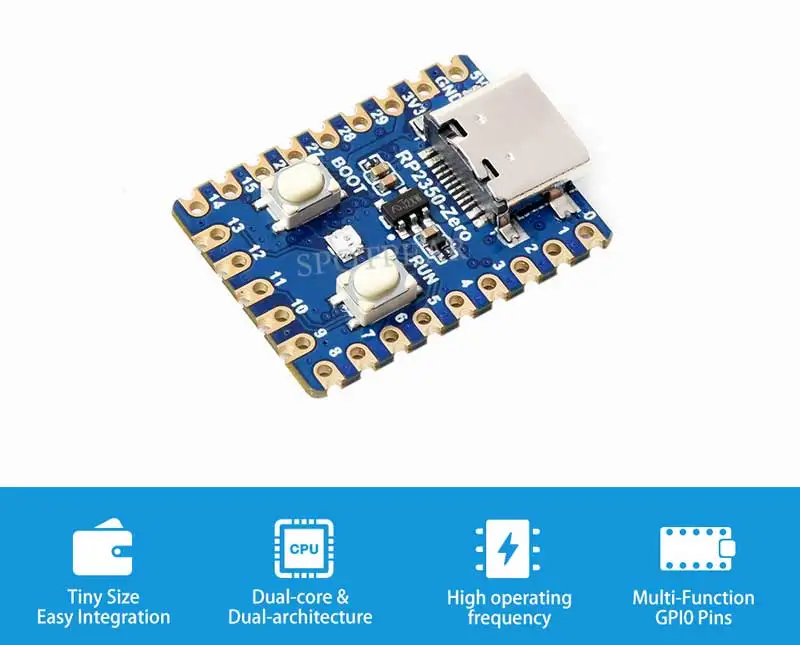
Product Features
-
Uses the RP2350A microcontroller chip developed by Raspberry Pi
-
Unique dual-core, dual-architecture, equipped with a dual-core ARM Cortex-M33 processor and a dual-core Hazard3 RISC-V processor, running at clock frequencies up to 150MHz
-
Built-in 520KB SRAM and 4MB on-chip Flash
-
Adopt Type-C interface, keep up with the trend of the times, no need to worry about plugging in the right or wrong direction
-
Stamp hole design, can be directly welded and integrated into the base plate designed by the user
-
Supports USB1.1 host and device
-
Supports low power sleep and hibernation modes
-
Drag-and-drop downloading via USB recognized as mass storage
-
RP2350A's 29 GPIO pins are brought out (20 can be brought out through pin headers, the rest can only be brought out by soldering)
-
2 SPI, 2 I2C, 2 UART, 4 12-bit ADC, 24 controllable PWM channels
-
Precise on-chip clocks and timers
-
Built-in temperature sensor
-
On-chip accelerated floating point library
-
12 Programmable I/O (PIO) state machines for custom peripheral support
-
Uses the RP2350A microcontroller chip developed by Raspberry Pi
-
Unique dual-core, dual-architecture, equipped with a dual-core ARM Cortex-M33 processor and a dual-core Hazard3 RISC-V processor, running at clock frequencies up to 150MHz
-
Built-in 520KB SRAM and 4MB on-chip Flash
-
Adopt Type-C interface, keep up with the trend of the times, no need to worry about plugging in the right or wrong direction
-
Stamp hole design, can be directly welded and integrated into the base plate designed by the user
-
Supports USB1.1 host and device
-
Supports low power sleep and hibernation modes
-
Drag-and-drop downloading via USB recognized as mass storage
-
RP2350A's 29 GPIO pins are brought out (20 can be brought out through pin headers, the rest can only be brought out by soldering)
-
2 SPI, 2 I2C, 2 UART, 4 12-bit ADC, 24 controllable PWM channels
-
Precise on-chip clocks and timers
-
Built-in temperature sensor
-
On-chip accelerated floating point library
-
12 Programmable I/O (PIO) state machines for custom peripheral support
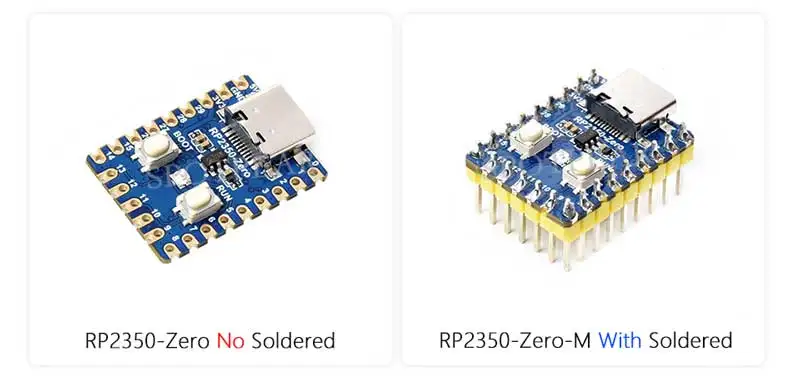
Version selection
C/C++,MicroPython
Complete SDK and open source tutorials are provided to make it easy to get started and can be quickly embedded into applications
Dual-core, dual-architecture processor
Onboard dual-core ARM Cortex-M33 + dual-core Hazard3 RISC-V processors
Running at up to 150 MHz
29 multi-function GPIO pins
Supports configuration pin function, which can be easily and flexibly developed and integrated
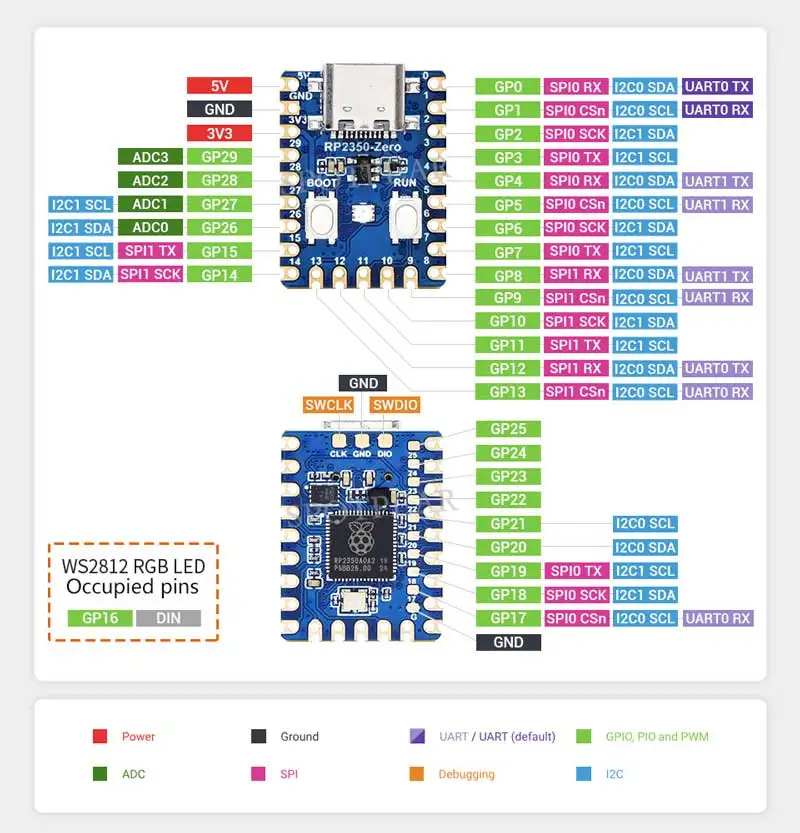
Resource Overview
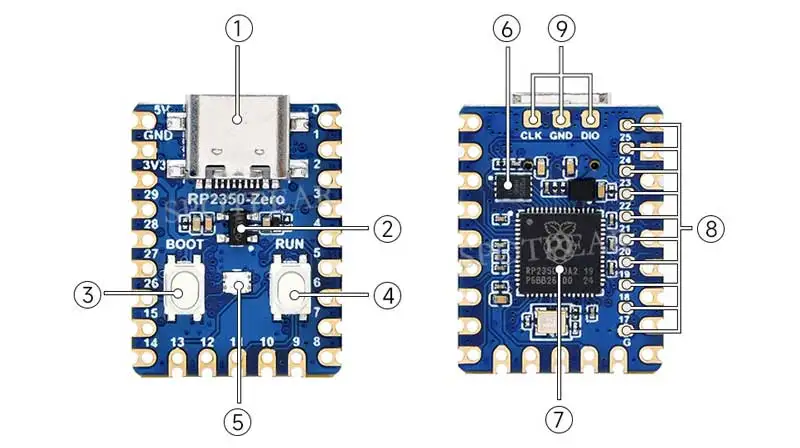
-
USB Type-C interface
Can be used to download programs and supports USB1.1 host and slave devices
-
ME6217C33M5G
Low voltage drop LDO, maximum current 800MA
-
BOOT button
Press during reset to enter download mode
-
RUN Reset button
-
WS2812
Cool RGB LED
-
P25Q32SH-UXH-IR
4MB NOR-Flash
-
RP2350A
Dual-core, dual-architecture processor running at up to 150MHz
-
RP2350A Pin Out
Lead out 10 pins (need to be soldered), 9 of which are GPIO pins
-
Debug interface
-
USB Type-C interface
Can be used to download programs and supports USB1.1 host and slave devices
-
ME6217C33M5G
Low voltage drop LDO, maximum current 800MA
-
BOOT button
Press during reset to enter download mode
-
RUN Reset button
-
WS2812
Cool RGB LED
-
P25Q32SH-UXH-IR
4MB NOR-Flash
-
RP2350A
Dual-core, dual-architecture processor running at up to 150MHz
-
RP2350A Pin Out
Lead out 10 pins (need to be soldered), 9 of which are GPIO pins
-
Debug interface
Product size
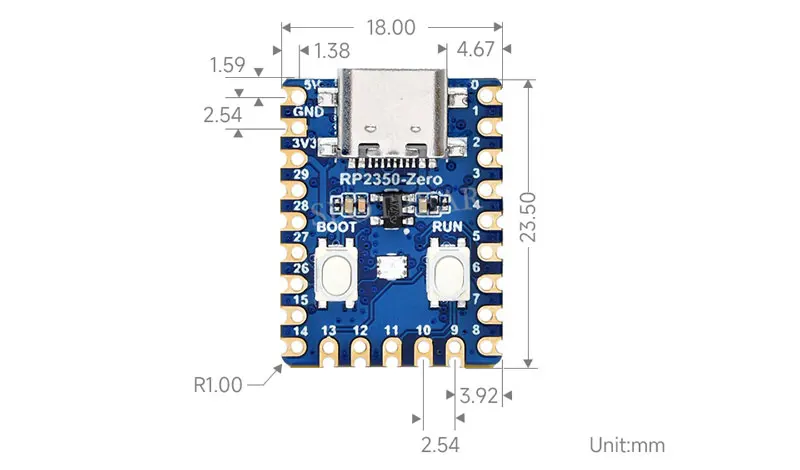
[] RP2350-Zero(Not Soldered)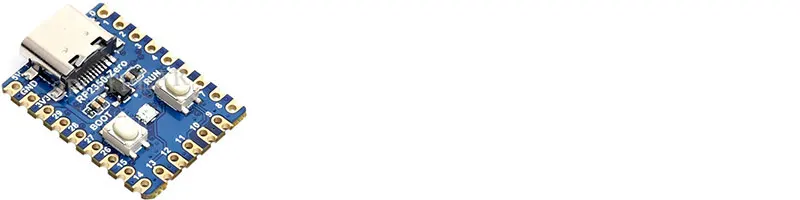
[] RP2350-Zero-M(Soldered)


There are no reviews yet.